
Lessons From Madrid

I do not wish to go through all the museums or major artists we saw. Picasso’s Guernica, for example, was, for me at least, spellbinding and is something I’ll write about on another day. What I do wish to point to now are examples of the things that I find very relevant for us plein-air painters today. So let me start with one impressive fact: Sorolla, as far as I know, was and remains the world champion in painting huge paintings in plein-air.
Here’s one example (featured image above), dapper dress mandatory. Sorolla relied on models, both of the two and four-legged variety. Consequently, he used his family regularly, with many beach scenes involving his wife and children, which today, especially in the context of small book-accommodating reproductions, give his work a “chocolate-box” feeling. In person, however, one gets the feeling of how raw, obtrusive, and immediate his brushstrokes, layering, and color are – altogether apart from the subject. In the painting above, I was struck by the scale of the horse, the visceral sense of its weight, its belly seemingly swelling out of the canvas. But let me begin with his drawing.

These gestural drawings were often in preparation of works in oil. Note the fluidity and simplicity. I wish I could do that!

Sorolla’s drawings are totally playful, mind and body are fused. A freshness and immediacy is in evidence throughout. When I look at this kind of thing, I also can’t help wonder, with the appointment of Tracy Emin as Professor of Drawing at the Royal Academy of Arts for example, if the sense of mystery and magic that seems to course through Sorolla’s drawings and so much of art at the turn of the last century hasn’t been entirely purged and thus made forbidden by today’s high-flying art world gatekeepers.

In the detail to the right (click image above to enlarge), we find that in areas where the light strikes the subject, the paint is very thick or impasto, helping to kick back light to the viewer so that the paint feels like light and not like paint. Note the brushwork. Sorolla is transcending the subject or getting past the facts. The subject is merely a prompt for Sorolla to express, then realize and complete himself.

In the above (click image to enlarge), I am showing you details taken from two separate paintings inserted. Notice the layering. In the detail to the left, Sorolla has scumbled foliage over the column and left it. You can see past it into the layer below which in turn has open or raw canvas coming through.
Similarly, in the detail to the right, notice how much canvas (which is not white but a light-to-middle beige color) is left open. Whether or not one leaves areas of the canvas, ground, coming through as Sorolla does in many of his later garden paintings (which while totally complete, are really just underpaintings), the lesson is clear: do not plug up the surface with the final layer.
I can’t emphasize this enough. Allow the viewer to peer down into the layers. Be playful. We are not making pictures of things that refer back to subjects. The subject is merely a prompt to which we respond by breaking down our visual experience into sensual pieces which we then put back together. The method I teach does this for us by re-integrating the pieces as we stay in the moment continuously. The process produces the work. That is its virtue.
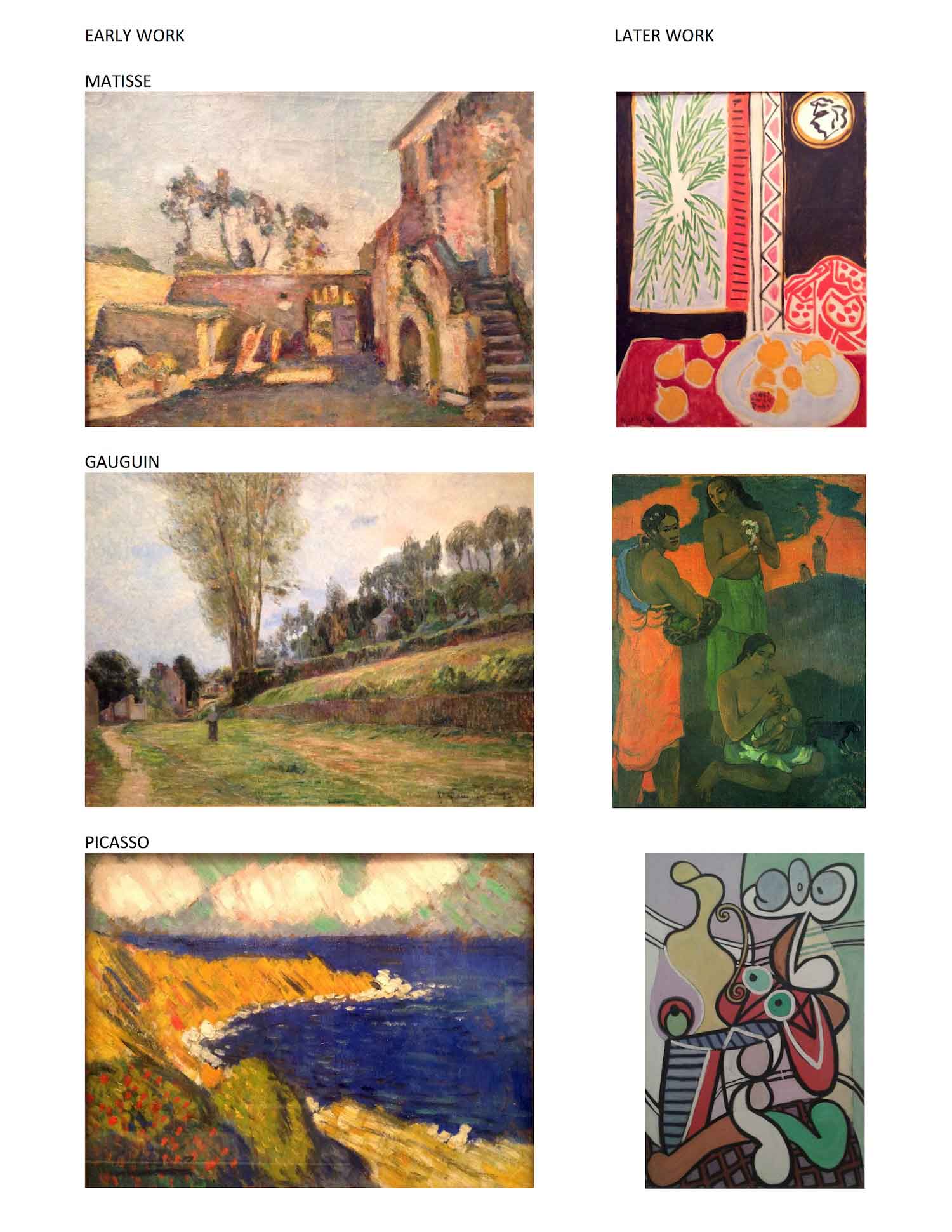
Okay! Put away your pads and pencils. It’s time for a surprise quiz. Below are three paintings (click image to enlarge). Who did them?


My take away is two fold:
- Training in traditional methods trains one to see, how to manipulate color and values, how to achieve harmony, or more simply, how to paint. It is the gateway to originality.
- Once you have mastered a traditional method (I’m not 100% certain about when actually but I’ll stick with mastered)- or at least when it genuinely feels constraining (as opposed to difficult or stress inducing), toss it out the window and create a method that is best suited to expressing your originality.
To see the answers, click here.
6 Comments
Submit a Comment
Address
Via Teresio Olivelli, 20
22021 Bellagio (CO)
Italy
+39 338 975 7135
Open Hours
Tuesday - Saturday: 11:00am – 6:00pm
Sunday - Monday: 1:00pm – 6:00pm
I’m so glad you made this pilgrimage to the sacred sites of Sorolla and the Spanish sun! I hope to follow your footsteps in the near future. As for your observations of painting and layering, the biggest aha for me is ‘do not plug up the surface with the final layer’. I have studied Richard Schmid’s landscape book for 20 years and wish he would have just put it that same way, like a decree – JUST DON’T DO IT! His illusive workmanship is a fine example of this theory of impressionism, too. Sorolla, who I have studied through our teacher here in San Diego, the late Sebastian Capella, is the glorious king of feeling and bravado. Sargent, Zorn and others had a clear vision of what is important and what is superfluous in their art. I always feel the ticking of an Eternal time-clock of fate speeding through their veins and out their brushes! Thank you for sharing your heart and soul in your beautiful insights and artwork. With gratitude, I wish you Happy Holidays. ~ Carole
Hi Carole, Thank you for a great comment. Best to you. Jerry
Jerry, great post as always. I’m curious to hear your comments on the Royal Academy’s choice of professor… You hint at an opinion here but I’d love to hear a bit more from you about that decision.
Thanks my friend!
Jay
Hi Jay, You mean Tracey Emin? I think I mentioned her in relation to Sorolla a blog or two ago.
Evidence I think that a corrupt oligarchy has taken over most of the world.
Amen! I was hoping that you’d say that. I hadn’t heard of her until I read your Sorolla post and when I looked her up… well, I was appaled and feel oddly insulted by the stunt (I think this qualifies as a stunt).
I would call it corruption.