
How To Be An Art Star? Tell the Right Story

The Islamic State (Isis) recently destroyed priceless artifacts in a museum in Mosul, Iraq, and in other places they demolished ancient churches, tombs, and statues. Shock has been expressed by commentators across the globe. These are appalling crimes, to be sure, and the perpetrators have been rightly called “thugs.” But shocking? I don’t think so. This is what conquerors do. Moreover, artists, in particular, need to understand that there is method to the conquering madness.
For example, after World War II, US forces destroyed “thousands” of Nazi paintings and “artists were also restricted in which new art they were allowed to create.”[1] Or if we go back to the 1920’s, we find our friends, the Saudis, smashing artifacts in a fashion similar to what we find our enemies doing today.[2] Or we can go back to the 16th century when invading Europeans, in the name of Christianity, destroyed a thousand years of Mayan artifacts and books.[3]
So what do we make of all this smashing and historical cleansing? Charles Taylor, in a different context, helps explain:
…a nation in order to have an identity requires and develops a certain picture of its history, genesis, development – its sufferings and its achievements. These stories envelop us and form our pictures of ourselves and our past, more than we are usually aware. [4]

Man at the Crossroads by Diego Rivera (note image of Lenin at far right)
The key word here is stories. Artifacts of culture authorized by the elites of history are intended to tell very specific stories. The essential reason elites in Paris freaked out over the Impressionists, for example, had less to do with their artistic innovation than it did with their disobedience; which is to say, that by refusing to paint images of Napoleon heroically marching about, or aristocrats looking noble, or religious images suggesting the order was a moral one, the Impressionists were, in effect, saying, “Go justify your own hierarchy. We quit.”[5] What is a ruling class to do? Or consider the “thug” Nelson Rockefeller, who, after commissioning Diego Rivera in 1933 to paint a mural (Man at the Crossroads) at the newly erected Rockefeller Center, had the piece jackhammered to smithereens. Why? Because in his concept of “man at the crossroads,” Rivera had inserted an image of Lenin and a Soviet Russian May Day parade. SMASH, SMASH, CLEANSED. Wrong story!
Here’s my point: if the proverbial man from Mars were to visit planet earth in order to find out what artists do, and were he to survey all the works of art for the past 10,000 years, he would report back and say, “Well, they do many different little things off to the side, but their primary task is to make propaganda pieces for various ruling classes.” And here’s where it gets interesting because here’s where the jobs are. Let’s look at two instances where artists were made stars because they were able to tell the right stories at the right time.
The Story Required by the Medicis
Suppose you are a cloth merchant who does very well, so much so that you accumulate so much money that you can do better as a lender of money than as a merchant of cloth. Before you know it, your family is in the banking business, and soon after that your family pretty much runs the world in which you live. If all this were true, you might very well have been a member of the Medici family of Florence in the middle ages. So here’s your problem: how do you convince people that your accumulation of unspeakable wealth and power over the “average Joe” is okay? One way of justifying your wealth and power, would be to frame it within a story of righteousness. Enter Cosimo I. His idea for a story was to have Greek Gods explain to the people, through works of art, that the Medici empire, in contrast to previous Dark Age barbarism, was a welcomed new era, a “rebirth.”
How did Cosimo spread the rebirth story? He founded an art school where ambitious artists would come and “decorate the walls of Cosimo’s medieval palace with stories of Medici courage, nobility, and achievement and turn the palace into a temple to the Medici dynasty.” The rebirth or renascita (in Italian) would come to be known to the world as the Renaissance.
Harvard’s historian Mario Biagioli has described the Medici’s use of art patronage in their rebranding efforts as “the first time in western history in which we have a systematic form of propaganda, of a regime that is in need of legitimating itself and producing a state ideology that is not existing.” It may not surprise you, however, that as the Medici dynasty declined, a new religious grouping headed by Dominican friar, Girolamo Savonarola, didn’t buy the Medici story (too much luxury) and “many great works were ‘voluntarily’ destroyed in the Bonfire of the Vanities.”[6]
The Story Needed by the US Just after WWII[7]
Following WW II, the US emerged as the hegemonic world power and commensurate with its power, it sought to be the cultural center of the world as well. What to do? Simple. Bring in the CIA. Why the CIA? For one reason, the top-down design of an art movement had to be covert. How can an art movement really be identified as a movement unless it bubbles up organically from the artists themselves, or appear to. Right? Just as important was the fact that in the post-war period, many of the world’s leading painters, writers, and musicians (many from Europe) had long embraced anti-capitalist values and many were sympathetic to Soviet ideology. Thus, the creation of an American art movement would become not just an important cultural weapon but a necessary cultural weapon just as the Cold War began. And one key instrument in this Cold War would be the Rockefeller family-run museum in New York City, or MoMA.[8]
Organizers of the new Western art movement stipulated that 1) it had to be entirely divorced from previous European art movements, and 2) it had to be entirely abstract, that is, it had to be “politically silent;” no more pesky Rivera-types painting pictures of Lenin. Naturally this killed off the careers of some top-flight artists, some protested, and the more ambitious ones simply flipped over to doing abstract art.[9] Now, you may be wondering, if the work had to be abstract, how could it tell a story? And how would that story have anything to do with the position of the US vis-à-vis the Soviet Union following WWII?

For one thing, it was said, abstraction was “the triumph of American painting, …vigorous, energetic, freewheeling, big.” Nelson Rockefeller referred to Abstract Expressionism as “free enterprise painting.” Chosen as the break-out star of the movement would be Jackson Pollock, a real American, a virile Marlboro-man type guy, born on a sheep ranch in Wyoming, influenced not by Europeans but by the Mexicans and Native Americans. Of course this was all BS; Pollock never rode a horse and left Wyoming as a young child, but who’s to know?
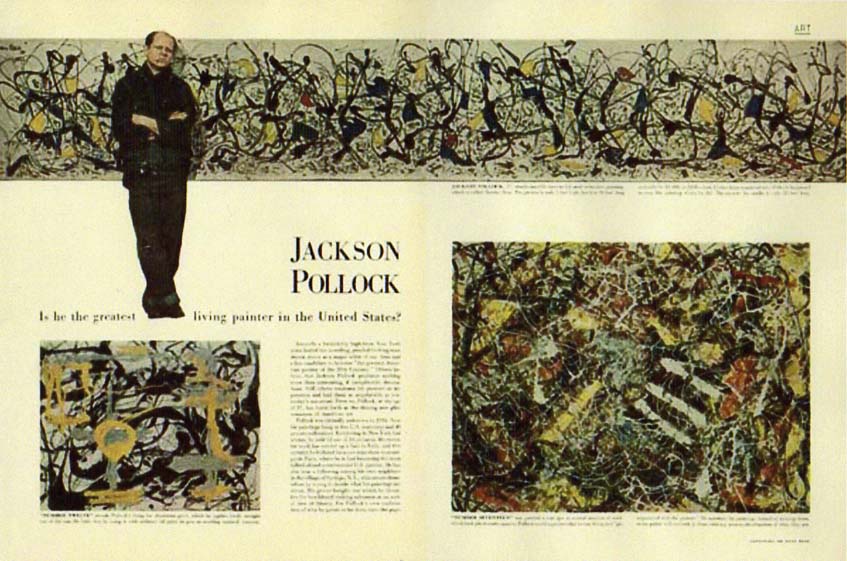
Painted stories don’t have to be true, just effective, as in what we fondly refer today as marketing and branding. Besides all this, the Soviets hated abstraction (and loved social realism) so it was very easy to draw a contrast and say, “Look, here it is, abstraction ‘in its infinite variety and ceaseless exploration;’” it is the “foremost symbol” of democracy.[10] In March 1949, Alfred Barr, the first director of MoMA, contacted museum trustee Henry Luce (of Time, Life, and Fortune) suggesting that Abstract Expressionism, as his boss, Nelson, had announced, was “artistic free enterprise.” Five months later, Luce had Life magazine publish a lavish piece on Jackson Pollock in which it asked its 5 million readers, “Is he the greatest living painter in the United States?”[11] A star is born.
Simple, eh? Now you too can vault to the top of the heap. Just be sure you are telling stories with your art that your ruling class wants told. But how do you know what they want? Don’t despair. Remember, trustees went through a good deal of trouble to take the teaching of art away from master artists in their studios, many decades ago, so it would be easier for you to get “proper” instruction. So just see what top university art departments consider to be “important” (hint: it’s not painting) and do that. If all else fails, there is always networking.
—–
[1] http://en.wikipedia.org/wiki/Denazification
[2] ISIS’s War on History, Zack Beauchamp, March 11, 2015, http://www.vox.com/2015/3/11/8184207/islamist-monuments
[3] Who Killed the Maya?, https://www.youtube.com/watch?v=SQU56gqyQyU, 4:53; The Mayan Kingdom, http://inneroptics.net/mayan_kingdom_book/decline/
[4] Charles Taylor, Sources of the Self (Cambridge, Harvard University Press, 1989),
[5] This “story,” of course is not the one with which we are most familiar; the story of artists simply doing their own thing, rebelling against established artistic methods, and creating work that outrages the “stupid” public is the one told over and over because it is, essentially, part of the story of our own self-understanding.
[6] http://en.wikipedia.org/wiki/House_of_Medici
[7] An important book on this subject is Serge Guilbaut’s How New York Stole the Idea of Modern Art (Chicago: University of Chicago Press, 1983).
[8] Frances Stonor Saunders, Who Paid the Piper? (London: Granta Books, 1988), Chapter 16. Nelson Rockefeller was an intelligence asset during and after the war. John Hay Whitney, William Burden, Rene d’Harnoncourt, William Paley (later of CBS fame), Henry Luce (of the Time-Life empire), Joseph Verner Reed, Gardner Cowles, Junkie Fleischmann, and Cass Canfield were trustees of the museum who also had extensive links, personal and otherwise, to the CIA.
[9] “In 1952, some fifty American artists, including Edward Hopper, Charles Burchfield, Yasuo Kuniyoshi and Jack Levine, attacked MoMA, in what came to be known as the ‘Reality Manifesto’….” Ibid p. 265. If you wish to see the impact of the requirement of total abstraction, look at the work and timeline of many of the key abstract artists like Pollock or Rothko, for example.
[10] Rene d’Harnoncourt, Ibid, 262.
[11] Louis Menand, Unpopular Front, The New Yorker, October 17, 2005; http://www.newyorker.com/magazine/2005/10/17/unpopular-front
12 Comments
Submit a Comment
Address
Via Teresio Olivelli, 20
22021 Bellagio (CO)
Italy
+39 338 975 7135
Open Hours
Tuesday - Saturday: 11:00am – 6:00pm
Sunday - Monday: 1:00pm – 6:00pm
Fascinating piece of writing and thought. I very much appreciate a fresh perspective on history and how things (actually) work! Sometimes it seems like we have been swallowed up by a giant marketing machine. So please . . . keep writing . . . painting . . . and teaching!
Thanks Patrick. Well, that’s how the world works according to me. You might go to Youtube and search for Chomsky and any of the following “Edward Bernays,” “Walter Lippman,” “Manufacturing Consent,” and/or “the propaganda model. I think he nails it as far as “control of the public mind” politically; but you see, all the parts must fit together in order to insure stability – movies, art, education, etc. Thus, I think, we need to be aware of the ways in which all of this encodes how we think, do art, live. And individual contributor or social movement that has contributed to our freedom, has done exactly that. It’s not just painters who have to tell a story – secundo me! JF
Great article. Expected you would mention that the CIA fostered and promoted American Abstract Expressionist painting around the world for more than 20 years for political reasons. http://www.independent.co.uk/news/world/modern-art-was-cia-weapon-1578808.html Yours, Bob
Hi Bob, Thank you for the reference. I will certainly check it out. I knew Greenberg kept on proselytizing but I now need to see how all that fits in with Pop Art supporters. JF
What a great piece, Jerry! I was not aware of the fact that MoMA was a Rockerfeller asset …We live and learn. Thank you for this insightful article.
Hi Maria – how are you? yes, Nelson, in particular, was very close to intelligence services before and after the CIA was formed, especially in Latin American. Nearly all, if not all the MoMA directors, were working with the CIA. JF
Geez Jerry – Have you been smoking too much weed? Reading lots of Dan Brown? How do you explain Mondrian? I have sent lots of prior comments but can never make it past the CAPTCHA thus not delivered. Best Regard, Joy McCormack
Hi Joy, no – not Dan Brown. Actually I wrote two long responses – but then I hit the wrong keys in both
instances and lost them both! So I need a break, but I’ll get back to you more substantively today or tomorrow. JF
Hi Joy, I am responding to part of what you are suggesting in my next blog and maybe I’ll do a future one on Mondrian, but quickly: elites have run the show forever, except for one brief period – that is when the Impressionists basically dumped the ruling class and went their own way. That is when elites lost control and for a brief period, artists were indeed independent and defined their own movements….but early in the 20th century, elites (now part of a capitalist economy instead of one based on aristocracy) saw the opportunities for investment and sought to gain control of art production. Primarily they would do this by pushing the teaching of art out of the studios and into the university which were and are corporate run. One major player in this regard was Bauhaus which wanted to end artist independence (“subjectivity”), collapse art and architecture into design, and insure that art had a utilitarian function within the industrial system. Mondrian fits in here….by reducing everything to line and primary colors he was essentially telling the story that elites wanted to hear, namely that all art is design, needs to be under an industrial or corporate umbrella and have a utilitarian function. Now, I am not saying that this is what was in his mind, consciously – as though it were some grand conspiracy. Rather I am saying that when any artist does things that serve the interest of the most power people in a society, they are more apt to be promoted than someone who is independent of power. Anyway, by the time Pop Art arrives, nearly all artists/painters got their training in universities. Artists became “executive” artists, working on a large scale with investors and corporations. Independent painters, easel painters completely lost control. Investors/marketing people call the shots as corporations and museums merge. The story: art is about new ideas, artists are about having managerial skills.
I would be interested in Joy’s response–one hopefully that is intelligently thought through and goes beyond infantile pokes.
I thank you for your support, Costanza, but I must add that pokes are welcome; I love to be challenged because challenges compel us to think more deeply about what we are saying. It’s like making a mark on a canvas isn’t it? There on the canvas we suddenly see who we are. We are made clear and then we reflect on that presence, change the mark again, and create who we become.
Hi Jerry: My incorrect CAPTCHA code swallowed my long and thoughtful reply! Makes me wonder… In summary – got a kick about my somewhat flippant remark being featured in your blog. Was caught flat footed about CIA involvement in art promotion. Did sound like Dan Brown. Guess he has lots of fodder from CIA. Do buy control by powers that be, particularly in the use of fear. However, did Pollock create his art as influenced by the CIA? Did Mondrian create his art to serve his corporate masters? Do artists want to be “Art Stars”? Do you? Don’t we all follow are own personal discoveries through our paintings?
In my opinion: Pollock was a jerk and was greatly influenced by what the Guggenheim crowd wanted/needed which in turn was influenced by the Rockefellers/MoMA, CIA, etc. Don’t you find it interesting, if you follow Pollock’s work – and many of the other AE artists – how they did a kind of “symbolism” for many years and then within a few short years everyone is doing absolute abstraction? Moreover, they were no slackers; they were astute and heavily into self-promotion. But Joy, don’t rely on me. I listed various sources. Get informed. Read a few books on the subject. It’s all very fascinating but when one really digs in, history (of politics, art, etc) begins to look like the proverbial “slaughter bench.” It behooves all of us to “see through appearances” and let the world know and feel who we are. Re Mondrian, see above. Real artists don’t want to be art stars; artists-as-entrepreneurs probably do. My motivation: to be who I am most – that is why I inveigh against power and try to point to the many ways we are compelled to work in channels carved out by the powerful to serve power. Re: your last question: I think that most of us live with illusions in that we believe we may be following our own personal discoveries but don’t you find it interesting that the “entrepreneur” is held up as the saintly innovator, creator – when he/she MUST BE profit motivated? Don’t you find it curious that while most everyone points to “money” as the bane of existence, those who point to the “profit motive” as a bane are considered to be something horrible to be discarded immediately? This may shock you, but in one blog where I carefully made a brief analysis, with careful footnotes, suggesting that the interest of powerful types shape our lives as artists, one person commented that I was as off the wall as Dan Brown!!! Gee – just where do those ideas come from? Okay, critical thinkers are all wet; everything is just and legitimate. Keep writing in.