Don’t Draw A Line: Draw An Inspired Line

I feel remiss in not writing more about craft. I worry that for the non-painter, the subject of craft may be boring. But alas, with workshops on the horizon, I feel compelled to wade into the craft-weeds, so to speak!
When I demonstrate the way in which I move from a white canvas to a complete painting, probably the one concept that students have most difficulty with is the concept that is called the “separation of values.” That’s a mouthful, I know. It’s painting jargon for the word “line.” Hang in there. I will tie this altogether in a moment, but let me toss in one other aspect to painting that is not talked about enough, if ever, especially in the context of craft.
The wonderful thing about painting from nature is that one is able to feel the liveliness and energy of the world in which we are born into and surrounded by, if only we take the time to examine the thing we are looking at with a degree of interest. If we slow down and open ourselves to nature, nature responds; it suggests things to us, reveals specificity that we all too often do not notice. This is what is meant when Robert Henri says, “Don’t draw a line, draw an inspired line.” But I’m getting ahead of myself, so let’s get back to the notion of values, first, and then move on to the lines that emerge when values separate.
1. What are Values?
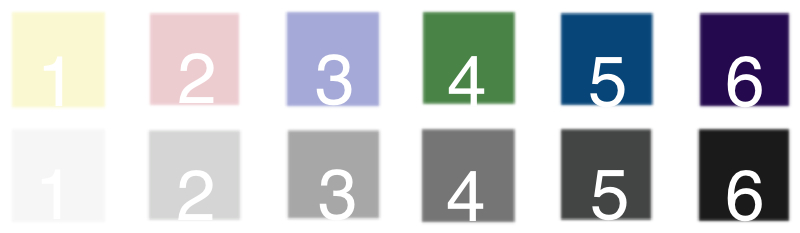
Above are six blocks of color. Below are the same blocks in black and white. You can see how the colors move from the lightest to the darkest. This is what is meant by the value of a particular color or thing; that is, on a black and white scale, how something is either dark or light in relation to something else.
2. Our Still Life (Note: it isn’t “still;” it is very much alive!)
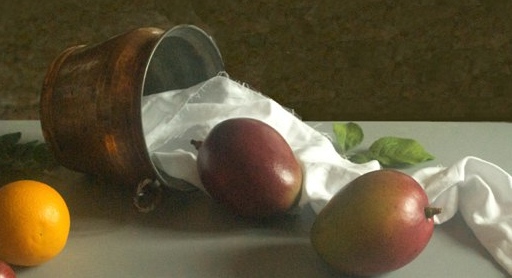
This is our still life that we wish to construct; therefore, we need to see and feel where values separate. Value separations and lines are the same thing!
3. First, We Must Squint
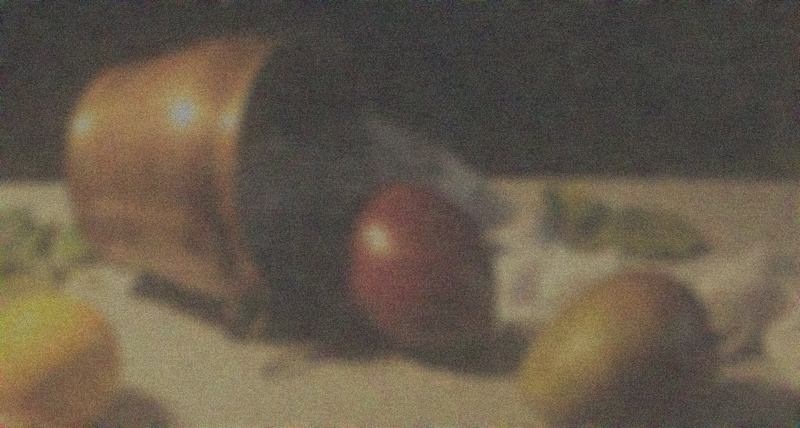
Whenever we paint, we must squint and then compare one thing against another. This is because we need to see relationships: what is darker or lighter than something else. (The same is true for judging color, by the way). So I have made the image blurry to convey the sense of squinting.
Squinting also enable us to see the whole or the emotional dust called atmosphere. Squinting enables us, then, to pass into a different realm of sensory perception.
4. Seeing and Feeling Value Relationships
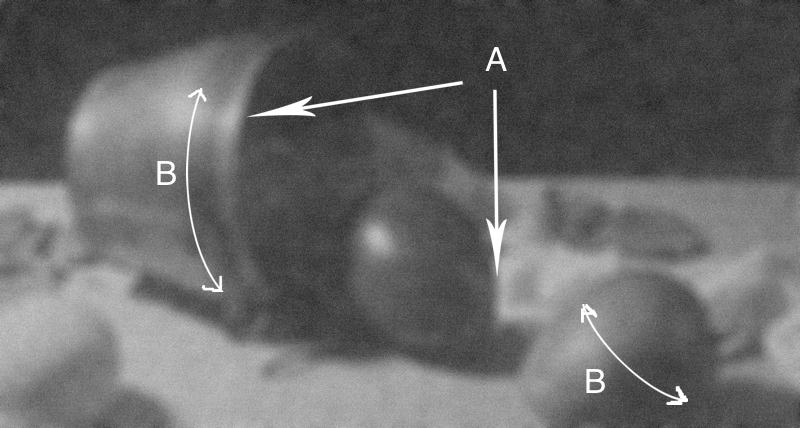
As we squint, we want to feel all the parts as one thing, the whole. In the image above I have eliminated color so that we can better compare values. With the letter “A,” I am pointing to two areas, for example, where I see values separating. We now see that a separation occurs where there is an abrupt change in value. It’s a kind of boundary. So, I place a line in these places, and the more intense the separation, the more intense the line.
In the areas marked “B” there are changes in value, but the changes are gradual; but there are no separations and hence no lines.
5. Placing A Line Where There Are Value Separations
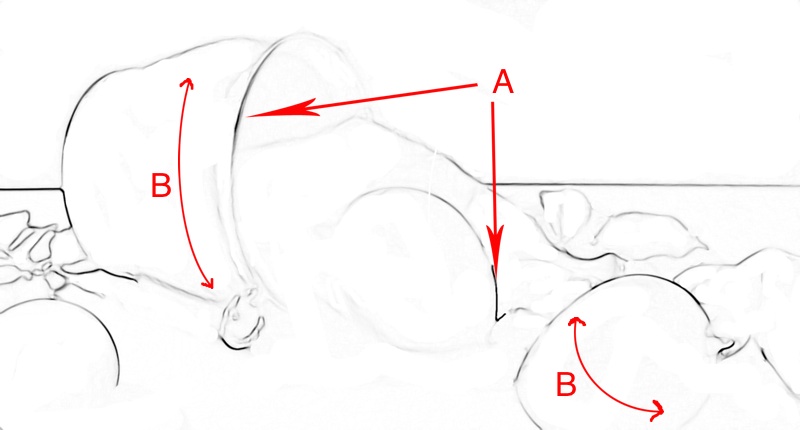
6. The Construction: Where We Perceive the Subject as Line
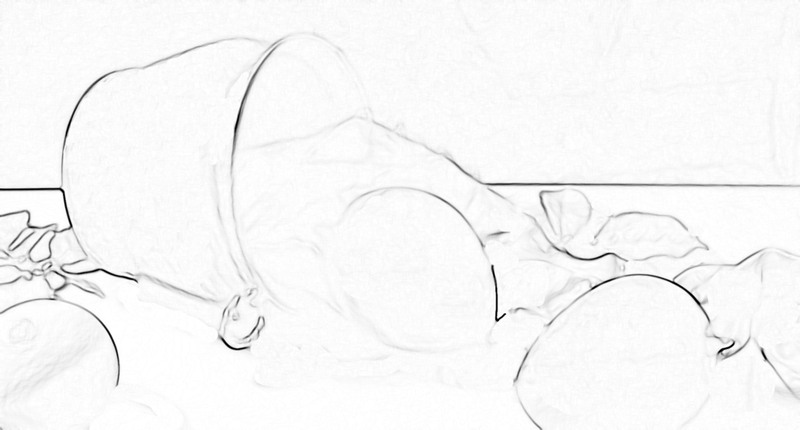
The image on the left is the Construction; however, it is computer generated from the above photos so it reads rather mechanical; which is to say, without feeling. Keep in mind that each stage is also a way to move into a realm of seeing where we experience just one part of the subject before us.
7. An Example From Real Life

This is a photo of the still life I used in a demonstration.
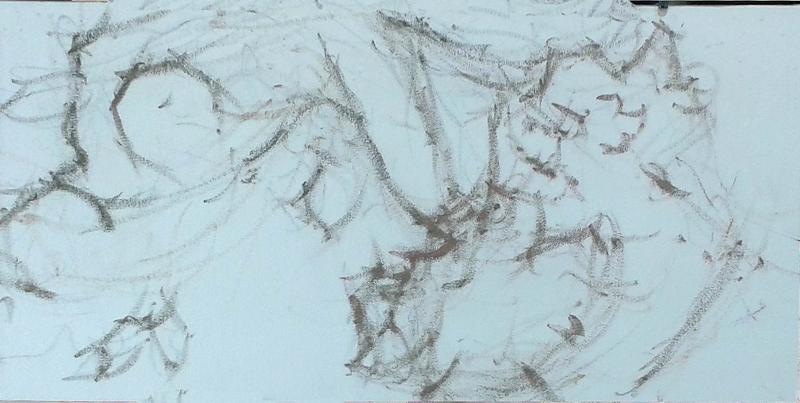
This is the stage, or passage, called Construction. I looked for places where values seemed to separate and in those places only I made a line (in oil).
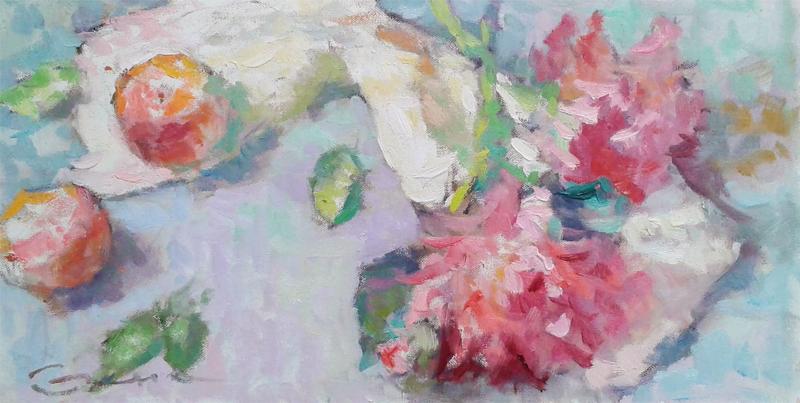
And this is the final painting from that demonstration. Obviously, there were other steps along the way, but I want to show you that we begin with a line drawing based upon value separations. Once we understand the concept of value separations, the key is trying to be one with your subject.
Remember: our subject matter is lively. It is not inert. Therefore, it is possible to feel the lines that nature reveals or suggests to us. Don’t draw a line, draw an inspired line.
A similar discussion can be had about color. But we will save that discussion for another day.
14 Comments
Submit a Comment
Address
Via Teresio Olivelli, 20
22021 Bellagio (CO)
Italy
+39 338 975 7135
Open Hours
Tuesday - Saturday: 11:00am – 6:00pm
Sunday - Monday: 1:00pm – 6:00pm
Thank you, this is helpful. Looking forward to Sunday!
Thanks Jane. See you soon! J
Thank you! Most helpful. Looking forward to next week!
I’m pleased that this helps. J
Fascinating. A clear, intelligent, way of thinking of and seeing value changes, and what you should be looking to draw on your painting surface.
Thank you Harvey.
Bravo! Thank you
I’m curious what light bulbs went off in your head?
Ths is most helpful! Let’s have more of it. I struggled for a long time on separation of values and often would get lost in the underbrush. What seems on the surface so simple requires a profound shift in the atomosphere of one’s mind. As a result of studying with you for several years I understand that the only way I am able to “see” value changes is to slow down or, better yet, shut off my analytical, chattering mind, keep looking and squinting.
I’ve started to do simple charcoal value studies aka notan. In your upcoming workshops next week in St. Petes I’m going to resist jumping into color on canvas and instead do a gesture study followed by a notan study in a sketch book. What do you think?
Hi Costanza: only you know best what you need to do next. I’m not sure what you mean by “notan.”
My fear is that you are making this step a big thing which will compel you to look for results and/or
correct. Looking for results and correcting separates you from the subject. The tendency then is to over
control. I would suggest this: don’t worry about it. It’s there in your head. Give great expression to the
sense of play; and most of all open to or submit to nature. Ask your subject matter: “Where do you want to
go, what do you have to tell me?”
If we try very hard we slip into a mode of wanting to master nature. Let nature reveal to you what you need to see.
Oh boy! Are value relationships the same for each person or do you see different values in each grouping?
Value relationships are the same, or should be, for each person. For example, the one thing that a camera can do well, if you take a black and white photo of the subject, is get the value relationships correct. What is darker (or lighter) than something else will always be so, even if everything is lighter (high key) or darker (low key). That is why you will often hear the critique of an inexperienced painter that his or her “values are off.” It is pretty basic and very important – if one wishes to achieve a sense of space. Of course, one may wish to distort and alter values and everything else that one sees, but then one would be leaving traditional painting. However, if one chooses to do that and if it is actually a “choice,” then one ought to have the ability to get the value relationships right in the first place. JF
Good explanation of seeing values and observing(seeing, feeling) nature but my comment is about a documentary on CBC (Canadian Broadcast Company). As you are in North America and as St. Pete’s has so many snow birds, they may carry a Canadian station. Naomi Klein’s book, “This Changes Everything” is the subject of the documentary on tomorrow (Thursday) evening. As you are a fan, thought you might want to catch it. Enjoy. Joy
Thanks Joy. Yes, I am a fan of Klein – but I just saw your comment, a day late. Maybe I can find it on youtube! J