
A Painting Demo

I just completed my two weeks of teaching here in Bellagio, Italy – on Lake Como. Classes were full and the students were great. For photos of the classes go here.
My classes have more of a school feeling than today’s typical workshop in that I ask students, regardless of level, to immerse themselves into a specific, structured method that was taught to me. The method comes from late-19th century Paris and was brought to the US by a student of Sargent (Ivan Olinksy) and by Robert Henri who studied at the Acadèmie Julian from1888-1889. Both Olinsky and Henri were teachers of Robert Brackman who, in turn, taught William Schultz, with whom I studied.
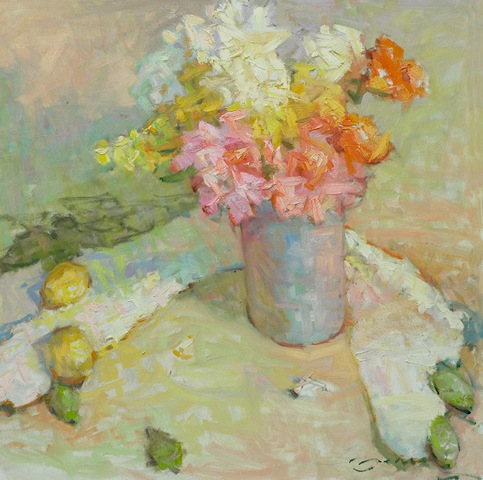
Below is the demo I did (25×25 in) for the first week’s class and I would like to show it to you. I placed some artificial flowers in a metal vase on the floor. It was illuminated by a halogen lamp (which is a warm light). Therefore, the light was unchanging and the flowers, especially given the heat of the lamp, wouldn’t wilt. I also included two lemons, a white cloth, and a few leaves. When I paint, however, I never see flowers, etc., as flowers; I see only line and color. I never look for results. I stay in the moment and allow the process to produce the work.

Composition: Using charcoal, I come to know the subject matter with gestural lines and lines indicating separations of value. This is an exploratory stage. There are no commitments. It functions as a dress rehearsal and answers the question, is the composition pleasing to me? Should I go forward in oil?

Construction: If the composition does please me, I erase the charcoal lines and now begin in earnest using oil. Without tracing the ghost lines from the Composition, I begin, really, for the first time with line, but this time in oil. I use a neutral color that is slightly darker than the white canvas and the thing begins to emerge out of the white canvas. It is a birth of sorts.

Underpainting: I now move into full color. I scumble the paint on, which is to say I use very little paint and I apply the paint in a “windshield wiper,” scrubbing type stroke, holding the brush down near the feral. I divide everything into 3 values: darks, middles, and lights. I begin looking for color among the family of dark values, then the middle values, and I leave the light values open or blank canvas. The paint, in this stage, should have the feeling as it were of breath on glass, or veils of atmosphere.

Reconstruction: I now go back to line, but this time the line is darker and has the effect of undoing the feeling of atmosphere that I achieved in the underpainting. The dark lines, then, compel me to begin building, stroke by stroke, richer, slightly darker separate pieces of colors. The Reconstruction functions as an armature onto which I place color.

Painting: In this stage, I open to the wonderful specificity of color. By not seeing flowers or lemons as flowers or lemons, I’m better able to see colors that I might not have noticed. I begin with and move around within the dark values. Then I paint the middle values, and finally I move into the lights or the areas of the canvas I had left entirely blank. I do not completely cover the underpainting. I want the previous layers, especially the underpainting, to show through so that when I stop, one can see down into the painting as though the last layer were lace placed upon lace. (Click the image to enlarge)
Caveats
There’s a big caveat to all of this. By presenting the painting process as I just have, one is tempted to think of it as a process of production or an assembly line of sorts where the work obtains value when it is “finished.” But it is not that way at all.
Think of the entire process as a pedagogy of the senses. In each stage, the sensations of line or color are simply prompts to which I must respond by touching the canvas with my brush, rendering my feelings in that moment and, in that moment, realizing who I am. That’s the payoff. The painting is complete in every stage much as a person is complete at any age.
In effect, I am laying bare the moving parts of painting. I am making an organic process visible, broken into parts, for the purpose of escaping my normal, everyday realm of perception and of entering into a realm of enchantment. My job, as teacher, is to make known the parts and how they fit together.
And the painting? Well, compared to the fulfillment that comes with witnessing my own realization, the painting is the next best thing. But keep in mind that the process produces the work.
Jenny’s Work
Here’s an example of the work of a young woman, Jenny, who did this her first week. She had hardly ever painted much at all and never painted in oils. It is her second painting out of doors.

It’s wonderful, isn’t it? That’s because she felt wonderful when she did it. The measure of a painting are the feelings you had in the process of creating it.
Art can be taught, but only when students understand that the process is all about getting a rush. That’s the point of picking up a brush. The painting just happens along the way.[1]
——————————-
[1] We organize painting workshops in both Italy and the US. In Italy, we hold two 1-week workshops in Bellagio in September. In the U.S., we hold two 1-week classes in St. Petersburg, Florida in February. Go here for more information.
lovely
Thank you Jessie. J