
On Getting Out Of Our Heads

The child sees everything in a state of newness; he is always drunk. Nothing more resembles what we call inspiration than the delight with which a child absorbs form and colour…. genius is nothing more nor less than childhood recovered at will. – Charles Baudelaire
A few weeks ago I was in Amsterdam. Seeing Van Gogh in the flesh, as it were, was a big part of the trip. The big take away for me was this simple insight: if I want to be a good painter, maybe even an artist, I need to get out of my head more!
Part 1: Enter Charles Baudelaire[i]
Baudelaire might be the perfect guy to help me get out of my head, to see and feel the world sensuously, to treat every line and color as a visual and sensual prompt to which I am compelled to respond emotionally. Look at the way he urges us, as artists, to do this:
You have to be always drunk. That’s all there is to it—it’s the only way….But on what? Wine, poetry or virtue, as you wish. But be drunk. And if sometimes…in the mournful solitude of your room, you wake again, drunkenness already diminishing or gone, ask the wind, the wave, the star, the bird, the clock, everything that is flying, everything that is groaning, everything that is rolling, everything that is singing, everything that is speaking. . .ask what time it is and wind, wave, star, bird, clock will answer you: “It is time to be drunk! So as not to be the martyred slaves of time, be drunk, be continually drunk! On wine, on poetry or on virtue as you wish.[ii]
 Isaac Israels
Or here, where Baudelaire in reviewing a painting by Eugene Boudin,[iii] suggests that paintings don’t need people in them. They don’t need to tell stories. Why? Because if you can get intoxicated by simply savoring the sensuality of form and color, then:
….all these clouds with fantastic and luminous forms, these yawning furnaces, these firmaments of black or violet stain….mount to the brain like a heady drink or the eloquence of opium….[iv]
And here’s the good news, according to Baudelaire: we are born relating to the world this way. As kids we are little intoxicated sensuality addicts (see quote on top). Kids are always drunk! Just look at the little painting by the kid above. It’s a flower but you would never know it. The kid is drunk, it seems, with the colors green and purple. I don’t think she even sees “flower.”[v] My teacher would always say, “Get it through the color.” Charles Hawthorne long ago urged us to paint “Color first, house after…not house first, color after.” But I prefer Baudelaire’s simple admonition: “Be drunk.” Now imagine seeing and painting like this not just as a child but as an adult, and forever. Baudelaire describes such an adult as someone “who is never for a moment without the genius of childhood – a genius for which no aspect of life has become stale….[She has]…insatiable passion – for seeing and feeling….” Insatiable passion for seeing and feeling? Whoopie! This could be the ticket. Good-bye living in my head.

George Breitner
Part 2: Enter the School Teacher
‘What is this, class?’ asks teacher reaching into her shoebox, holding up a red toy truck about two-and-a-half inches long. ‘A truck,’ answer the first-graders in unison. ‘What is it for?’ ‘Going places,’ says one; ‘Carrying stuff,’ says another. ‘What is this?’ ‘A cow.’ ‘What do cows give us?’ ‘Milk;’ ‘Ice cream,’ says someone in back. ‘And this?’ ‘A house.’ ‘Are you sure it’s not a store or a barn?’ ‘It’s where people live.’[vi] In this example, suggests Stephen Parrin, students are taught “to think in terms of broad categories of utility. She is having her students sort the world conceptually in terms of labeled ideas, not firsthand experience (emphasis added).”[vii] Sensory details don’t exist. And after 12 years of education, Parrin believes, “the ability to savor their sensory experience had been stripped from them.”[viii]


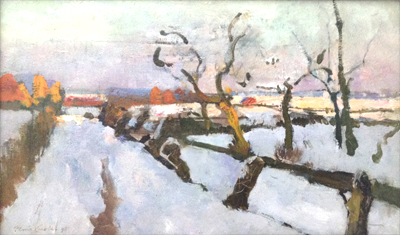
Floris Verster
In other exercises, Parrin found that even when students were on a walk, exploring blindfolded, as soon as they identified an object as “pinecone,” “rock,” “stick,” “tree,” “grass,” or “gravel,” they moved on to something else without pausing to explore “the feel or smell of what they had touched. Their approach was wholly and uniformly conceptual.”[ix] It is not surprising, then, how now as adults – and even as painters staring for hours at a subject matter – we “wholly bypass personal experience.” We have been taught to live in our head.
Part 3: The Exhibition
The one thing nice about visiting new museums is being introduced to new (albeit long since departed) artists. In addition to Van Gogh, I’ve posted images from the work of George Breitner, Isaac Israels, and Floris Verster. Breitner and Verster were contemporaries of Van Gogh. Verster came along a little later. I was impressed by their authority. It just jumped off the canvas. They were really in control of their craft. And I loved their amazing simplicity and tonality.
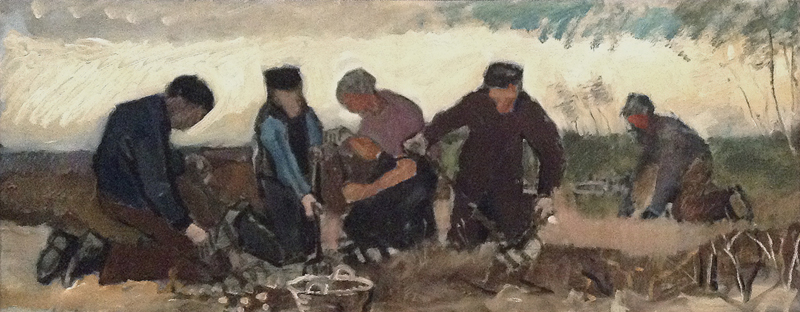

Van Gogh, Potato Diggers
It was nice to see some of Van Gogh’s famous paintings but I found the work of his that I had never seen before to be even more powerful. An example was his Potato Diggers (above). Lose. Simple. Direct. What impressed me most about Van Gogh was how even in the work that didn’t make my list of favorites, the charm and sincerity of his personality was powerfully present. As much as I like the other painters mentioned above, their passion for seeing and feeling is less on display, hidden to a degree by skill and convention. Not so with Van Gogh who makes himself entirely vulnerable, with all his against-the-rules way of painting.[x] He really puts himself out there, like the painting below (VG2). There is a lot about this painting that seems off or wrong. And yet, the more I looked at it the more I got drawn in. Everywhere on the canvas he is alive, intoxicated, drunk. The painting just follows. It’s a by-product of his intoxication.

Van Gogh, VG2
Part 4: The Question of Talent
Baudelaire was critical of the concept of genius and/or talent shared by most at the time – namely that it is a rare thing, genetically endowed. It is a concept that still haunts us and inflicts enormous self-doubt upon everyone. Do I have talent, we all wonder? Am I good enough? Baudelaire’s insights alter the equation. For visual artists, it’s not about measuring up to some arbitrary standard; rather it’s about the ability to retrieve that state of innocence and sense of wonder that comes from engaging the world, not just through categories, but sensuously as well. Or to put it another way, instead of the concept “talent,” substitute “sincerity” or “freedom” and ask: am I sincere? Am I really free to be who I am? The good news then is that there can be no one who anoints or announces or declares an artist to have talent. It is the province of everyone. Each of us feels fulfilled and exhilarated as we exercise and discover our power. Every human being begins life with the intense passion to see and feel. And then as we develop our ability to see everything through categories, our ability or freedom to savor our sensory experiences is neglected. It withers. Van Gogh seems to have escaped this trap. He was drunk his entire short life. No talent. Never a martyred slave of time.
Address
Via Teresio Olivelli, 20
22021 Bellagio (CO)
Italy
+39 338 975 7135
Open Hours
Tuesday - Saturday: 11:00am – 6:00pm
Sunday - Monday: 1:00pm – 6:00pm
0 Comments