The Danger of Huge Opportunities

“Don’t see the subject except as sensations of light. The subject is merely a prompt that you, the painter, must respond to, by making marks that express the feelings that these sensations evoke within you, “ so I often explain to students. The idea is simple enough, I suppose, but it doesn’t seem to take. It doesn’t open doors or release floodgates as it should. My sense is that this idea is more of an obstacle for students. It took me years before it sunk in. I think I know why.
To be a painter, one learns a craft or a method – yes, we know that. But what we don’t often think about is how the culture we inherit “encodes” or shapes a “set of behaviors, understandings, and expectations.”[i] This encoding comes into sharp relief, however, when one contrasts the self-understanding of many great painters (and writers) during a one hundred year period (roughly 1850 – 1950 or from Delacroix through to Matisse) with the general self-understanding among painters today. Let me contrast the difference this way: the former self-understanding seems to have been centered in an overriding rejection of values and practices they called bourgeois. Yet today, the reverse is true: the self-understanding of painters seems to be centered on the celebration of values and practices often called entrepreneurial (the friendlier term but one that is equivalent to bourgeois).
Understanding this sea change may never be part of a course on painting. But that’s a shame. It is an important thing to understand, I would argue, if you want to be a good painter, certainly as important as learning a specific method. It may just set you free. I think I can show you why.
Recently, I received one of those solicitations to participate in a painting competition. But what made this solicitation interesting to me in this context was that it expressed nicely today’s cultural encoding that I wish to illuminate. It helped me understand why the mentality of 19th century “how to paint” teachings may feel like square pegs in today’s round holes.
The Competition: Painter as Entrepreneur
There are many examples one could use to illustrate the values and assumptions that are part of the bourgeois or entrepreneurial mentality of today’s art world. The impact and role of speculation, for example, would be central, but let’s focus only on this particular competition solicitation.
- The promoter of the competition begins by passing along “wise advice” from “one of the best marketing minds in the world” who is identified has having generated “BILLIONS for thousands of corporations (emphasis in the original).”
Note the assumption: This guy can make serious money for painters just as he did for corporations. Painters and corporations are the same in essence: market actors in the game of making money.
- We painters are instructed “to be relentless” about building our “brand,” “getting noticed,” developing “credibility boosters,” and establishing “social proof” that will make some of us painters “perceived as more prominent…than someone else.” Why? Because, “If you have been…selected by the best judges, by the highest authorities, that tells me, the collector, that I’m getting the best.”
Note the assumption: The highest authorities know what good art is, not the collector, and not even the artist.
- Pay your $35 entry fee and “put yourself up against the best.” And if you don’t win, “you just have to keep putting yourself in the game” because this competition “elevates your painting.”“
Note the assumption: Painters acquire success by aligning themselves with, and by putting their work in tune with the tastes, sensibilities, and interests of the best judges in the land. The highest authorities know more about the direction a painter should take than does the painter herself.
- What’s the payoff? “Winners are to receive large cash prizes and features in a national magazine,” which in turn leads to “the nicest studios…the biggest travel budgets.” Winning artists are given “some important rights to tout their acceptance by the best judges in the land.” You might even get “[your] work on the cover” which is like “striking gold.”
Note the assumption: We have come full circle. Painting is an enterprise like any other; naturally then, the success of the painter, as with other entrepreneurs, is measured by capital accumulation, by striking gold.
Also note the relationships of power that are being constructed. Painters must be in the game so that they can be led to the better world that their superiors plan for them. The highest authorities select those painters who will move forward in their careers. This is all about the subordination and obedience required of the successful painter. But it is encoded differently. It is a “huge opportunity” to “be the best painter they [sic] can be.”
Early Resistance to the Rise of the Entrepreneur
It was a very simple idea that completely pulled the rug out from under the highest authorities of the art world in the mid-19th century. One’s focus as an artist (writers as well as painters) would not to be on things themselves but on the effects or feelings produced by things within the artist. If writers and painters were to be free, the argument went, they wouldn’t be under the direction of judges, writing about or making pictures of people and places they never knew and felt. Instead, they would be expressing the feelings that nature (things and places in their life) made upon them. This meant that the highest authorities were out of the picture altogether (pun intended); their interests, their power over, their direction would be gone, irrelevant.
The corollary idea was explosive: artists can only fully know this nature through articulating (through painting or writing) what they find within themselves. The obedient artist would be displaced by the independent artist. Said Delacroix, as early as 1850,[ii] “The subject is yourself…you must look within yourself, and not around yourself.” This meant that painters would stop describing or making highly finished pictures of political and religious rulers. Instead they would be responding to the “sensations” of a vibrating nature, as Camile Pissarro would explain to a young Cèzanne. Matisse, decades later, continued to talk about “organizing sensations” and that “you have to put some faith in your own gifts and surrender yourself to the promptings of nature.” This sentiment echoed Monet who said that what was essential about his approach was that he stood before nature in a posture of “total-self surrender.”
But it gets better. In the process of rendering feelings, the painter not only becomes one with nature more profoundly but also comes to know herself by realizing her powers more deeply. Joachim Pissarro (great grandson of the artist and curator) has said, therefore, that painting at its most fundamental level, is a process of “becoming.” Becoming the best painters we can be, within this approach, is to become better to feel joy, caught up and carried away by pleasurable feelings of being charmed, like Manet who was said to have “fallen under the influence of the moment.”
Further, each of us will be moved differently for what moves us is our place of originality. Camile Pissarro, when noting the dissimilarity between his work and Cèzanne’s despite their shared approach, said: “each one kept the only thing that counts, his own ‘sensation.’”
And what role did bourgeois authority play in this? As I said, they played no role. Baudelaire, a writer close to Manet, explained in 1863: The artist “must be truly faithful to his own nature. He must avoid like the plague borrowing the eyes and the feelings of another man, however great that man may be; for then the productions he would give us would be, in relation to himself, lies and not realities.”
Unlike the collector above who depends on judges in order to know what to buy, Zola, writing in 1866, said, “I wish that one should be alive, that one create with originality, outside of all according to his own eyes and his own temperament. What I seek above all in a picture is a man and not a picture.”
Pissarro emphasized “the freedom of your own brush” and that “a work of art is a work of art only when the art truly reveals himself.” And Matisse again: “If you work for others, you never get anywhere….a work is a maquis where you have to find your own way.”[iii]
I could go on. Robert Henri believed that juries were just a way for one group of people to control the work of another, that we would have more success if we stopped thinking about it. Mary Cassatt’s forceful response to an award given her expresses the spirit of the age:
I…must stick to my principles, our principles, which were, no jury, no medals, no awards….Liberty is the first good in this world and to escape the tyranny of a jury is worth fighting for, surely no profession is so enslaved as ours.
The Danger
Under this fine rain I breathe in the innocence of the world. I feel colored by the nuances of infinity. At this moment I am at one with my picture. We are an iridescent chaos, I. I dream before my subject, I lose myself in it….The sun penetrates me soundlessly like a distant friend that stirs up my laziness, fertilizes it. We bring forth life.
Cèzanne
To paraphrase Foucault, my desire in contrasting the early critique of the bourgeoisie with the unreflective embrace of entrepreneurialism today is not to say that today’s entrepreneurial activity in the art world is bad. But it is to say that it is dangerous. It works to subvert the independence and autonomy required of people who wish to enjoy their lives as rich expressive activities, each life different in its originality, each person measured by a different yardstick.
Not surprisingly, the critique of the entrepreneur is not something widely shared. It’s not in the air. Consequently, the painter, today, has no alternative conception against which to appraise her condition, despite this rich history of genuine and successful resistance to a previous set of highest authorities. And not surprisingly, the story of the rise of Impressionism is not presented as a movement that was subversive of the artist-as-entrepreneur. It is presented as it’s opposite, as the expression of bourgeois values.
Let me end with a last alternative example. My teacher, Bill Schultz, when he was 40, was so frustrated with his line that he did nothing but draw for a solid year. His teacher, Robert Brackman, in order to better understand the tonality of atmosphere, did nothing but underpaintings for seven years. I really don’t think that relentlessly entering competitions would have helped either one of them become who they were as painters. At most they would have learned how to win prizes. To paraphrase Charles Taylor, painting for “the prize” lacks the force of depth, the vibrancy, the joy which comes from being connected to the èlan of nature and may constitute a bar to artists ever attaining it.[iv]
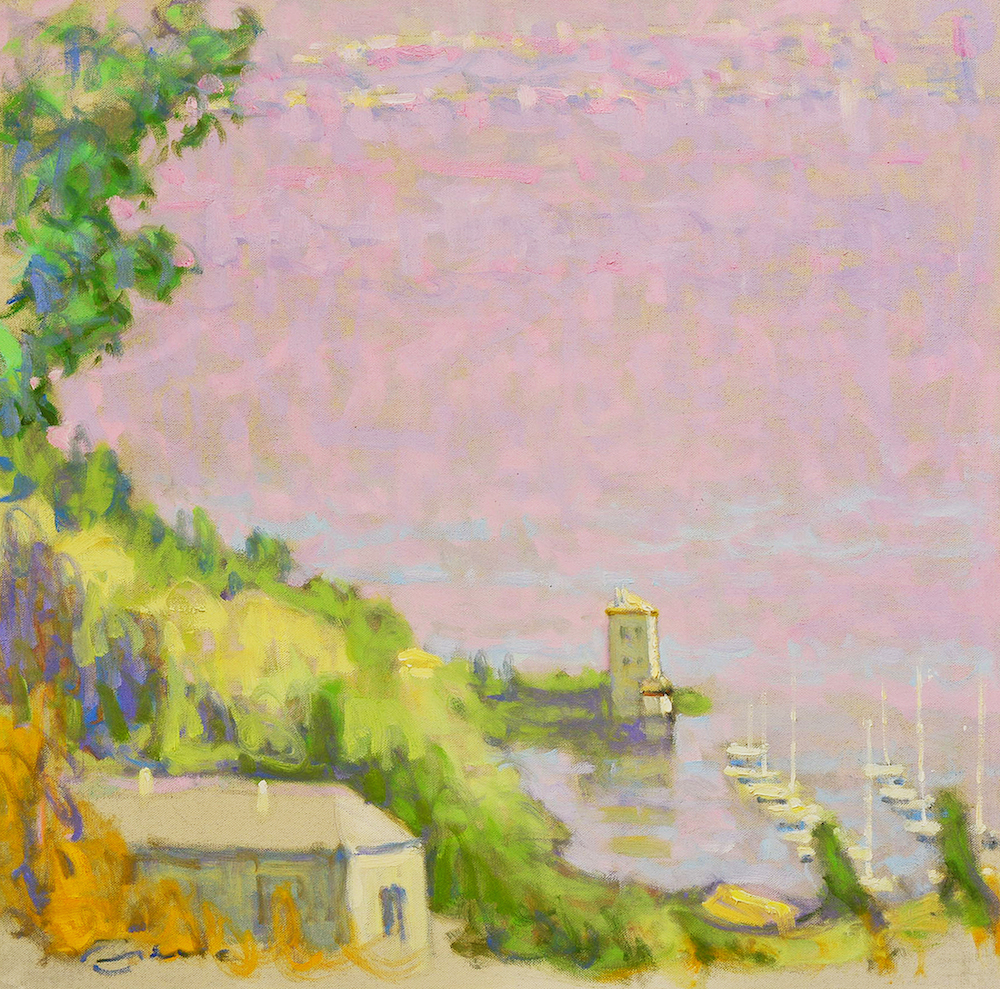
NOTE: The featured image at the top is by Jerry Fresia, “Harbor Below”, oil on canvas, 24×24 in (click here to enlarge)
[i] Robert Paul Wolff explaining the encoding of culture. See his blog: http://robertpaulwolff.blogspot.com/
[ii] The dates in this context are important. The set of independent Impressionist exhibitions were from 1874 to 1882. That Delacroix was thinking these thoughts in 1850 and the others I refer to in the 1860s indicates just how long and intensely these ideas were percolating among artists.
[iii] A maquis is a thicket or maze that one must find a way out of by herself.
[iv] See Charles Taylor, Sources of Self, p. 383
2 Comments
Submit a Comment
Address
Via Teresio Olivelli, 20
22021 Bellagio (CO)
Italy
+39 338 975 7135
Open Hours
Tuesday - Saturday: 11:00am – 6:00pm
Sunday - Monday: 1:00pm – 6:00pm
Aloha! I enjoyed your writing. I just finished a commission for five paintings of horses. I had never painted them before and was going to have to find my own way. The client gave me freedom to tell the story of her two horses with just a few notes of reference. No pressure except what I put upon myself.
This is significant as my initial studies were in the mode of pleasing the client as I would have done when I was in the gallery mode. Something happened along the way, when I began to experiment with some materials I had on my studio shelves one night. I picked up some gold foil from another project and it lit a fire in me. Applying that to the first canvas was freedom. From then on my ideas flowed to work between the five canvases until I finished in a flourish.
What fun I had not trying to please any particular audience, not even myself. Just experimenting and problem solving the materials. Liked Pissarro comment.
Thank you aloha Pam
Good for you Pam and thanks for letting us know.