Painting Venice, Thinking Matisse

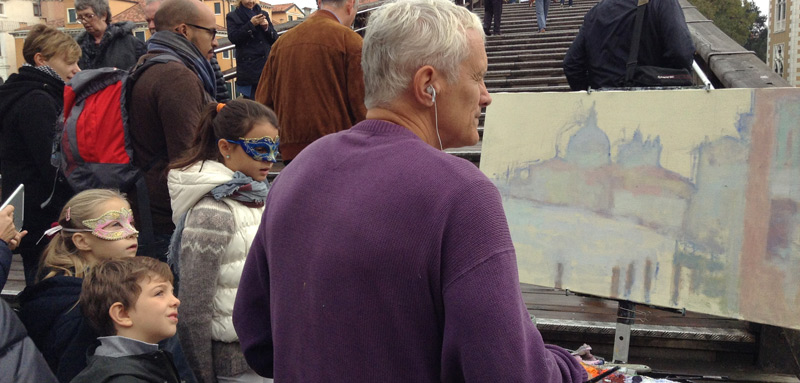
I made a painting trip to Venice in early November. The only constant was the constant change in weather – fog, clouds, sun, rain, flood. Not ideal conditions for a plein-air painter. But the challenge was fun. The crowds congenial. Only one critic stepped forward, a man who stuck his head into my space, to tell me that my composition would be better had I left more sky (see composition below).
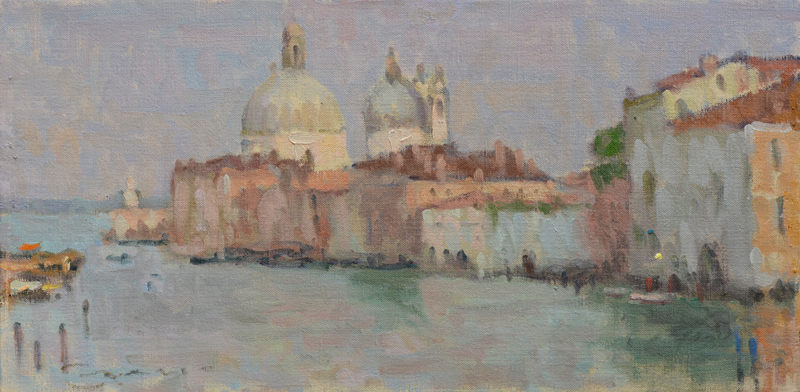

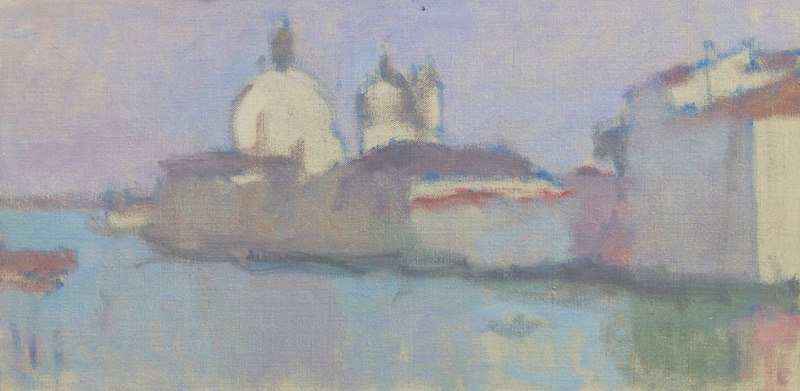
As many of you know, I use the Impressionist method of breaking down the painting process into 5 stages, each complete in itself, which is to say there is no endpoint in mind or finish except in the sense when I have nothing more to say, I stop. And in that sense the painting is finished. For example, the painting below is the third stage or “Underpainting” of the painting above. In this stage, I’m looking for color only. At first I “scumble” in just the dark values, then just the middle values, and I leave the light values open or plain canvas. Therefore, in this approach, I never see the subject as buildings, water, etc – just veils of atmospheric color in this stage. In this stage then, I establish the tonality of the thing that I’m looking at.

There are many artists who believe that cranking through such a structured method is confining, that the very creative process is being controlled, or dictated in a sense. Teaching such a method, it is argued, stifles the little genius within. I remember Wolf Kahn articulating a philosophy somewhat akin to this point of view. In fact, when he taught, he steered away from anything that had to do with “how to.” He didn’t really demonstrate. It all turned on expressing yourself and then a critique of the results by Wolf would follow. Methods, as such, were little cages to be shunned. In such classes, “coaching” displaces teaching; specific structured methods are not taught, nor should they be.
Sadly, only visual artists seem to have made a principle out of this “just express yourself” belief. Dance, theater, cinema, writing, and music are art forms steeped in rigorous instruction. Music may be the one art form in which it is easy to understand how creative expression and intense study of structured methods are symbiotic. Improvisation exists within a structure, for example. And in music and unlike in the visual arts, one can do “important” work and express oneself creatively through a mode that is centuries old. Structured modes, rigorous demands regarding keys, harmony (or not), timing and the like are not understood as so many cages but a language that enables expression. Hence, playing Mozart is still relevant.
Given all this, I was tickled to read about Matisse’s views on this given that he is a favorite of Kahn’s and emblematic of unbridled expression. Matisse himself was a product of rigorous academic training; however, he thought that his particular academic training was “deadly for young artists.” [1] But Matisse didn’t confuse Parisian academic training (that served the interest of a ruling class) with rigorous training per se. In 1908, when he formed his own school, he noted the following:
The few exhibitions that I have had the opportunity of seeing during these last years, makes me fear that the young painters are avoiding the slow and painful preparation which is necessary for the education of any contemporary painter who claims to construct by color alone….
An artist must possess Nature. He must identify himself with her rhythms, by efforts that will prepare the master which will later enable him to express himself in his own language….- everything that will let him become one with Nature, …that arouse his feelings.” [2]
And in a criticism of a student Matisse said, “The model must not be made to agree with a preconceived theory or effect. It must impress you, awaken in you an emotion, which in turn you seek to express.” [3] Couldn’t have said it better myself.
The inference I draw from Matisse is this: there are some structured and rigorous methods that are deadly, largely because they are intended to control the product and therefore the process. There are also structured and rigorous methods that liberate, that awaken in us emotions and provide us with the ability to express ourselves in our own language. Our task, then, is to know one from the other and not to throw the method-baby out with the bath water. Or to make the case from a painter’s point of view, I would never have learned to see and be moved by atmospheric color if, when I painted, I were not asked to see the thing as enveloped by the most seductive atmospheric color – each and every time I painted.
Here’s the real kicker: structured and rigorous methods are necessary, yes. But also important is what Matisse’s life example teaches – and as my teacher would always ad as a caveat to his teaching: at some point, take the method and throw it out the window. By doing so, Henri eventually became Matisse. It’s all about becoming the people we are most, you know.
All of which begs the question: so when do we chuck the method? I think one would first have to master it before tossing it out the window. And it would have to feel constraining, I suspect. But I’m not sure. I haven’t gotten that far.
7 Comments
Submit a Comment
Address
Via Teresio Olivelli, 20
22021 Bellagio (CO)
Italy
+39 338 975 7135
Open Hours
Tuesday - Saturday: 11:00am – 6:00pm
Sunday - Monday: 1:00pm – 6:00pm
Hi Jerry.
The tourist in Venice was dead wrong. No more sky. Such a good blog post. I wrestle with this often. Recently I started shifting how I start a painting. I liked the way it felt. But…I still wanted/needed a strategy…a way through. In no way does a plan crimp my creativity. That throughline guides me and allows my instincts to unfold. For me…it’s about balance. Creating some kind of balance of my pure self with what I have learned and allowing the good teacher voices to mostly remain while banning the bad teacher voices out of my studio! xo Cynthia
Hi Cynthia, Thanks for your thoughtful comment. If you wish to respond to my blog, and I know you have a lot
to say on the subject, I’d be happy to post it. It’s an interesting subject. How to achieve direction, a way
through, a strategy as you call it…and not shut down the unexpected, the spontaneity, the surprise. J
More and more your writing presents a clearer vision of art and through time relevance of your pursuit for purity through the painting the form becomes revealed. Plein air painting as you perform proves you are a unique sportsmen; fearless, aiming beyond the seen stars, in pursuit, competitive to and friend of God. Bless your endurance.
Thank you Michael. J
Thanks Michael. How are you? JF
Just loved the latest newsletter! Venice, Matisse, Mozart, and Jerry painting – all yummy.
Still struggling with the method but loving the struggle! Getting there, slowly. Will share soon … it’s really cold outside right now!
Best wishes,
Maria.
Hi Maria, nice to hear from you; I trust you are doing well.
J